20 metres, 30 years, 80 % survival: what Wallonia really asks before it funds your planting
Wallonia's planting grant is open to private individuals, but its thresholds are sized for the countryside. What they exclude, and what the grant actually pays.
You have decided to plant this autumn — a hedge at the bottom of the garden, a few fruit trees, a bank to clothe. And then you came across that sentence: “free plants are over in Wallonia.” Does your project still stand?
It does. But not on the terms most people imagine. We went through the legal texts, the payment scales and the nursery price lists: here is what the Region asks in return, and what it actually puts in your pocket.
What stopped, what continues
Two schemes that everyone confuses.
What stopped: the batches of plants from Yes We Plant, supplied in kind to large-scale projects — 1,200,000 plants allocated since 2020, closure confirmed by the Walloon public service. With a garden, you never had access to them.
What continues: the Week of the Tree, at the end of November. Municipalities hand out plants free of charge, in limited quantities and on varying dates — ask yours.
What has not changed: the planting grant. That is the one that matters here.
You are entitled to the grant — farm or no farm
The least well-known point first: Wallonia’s planting grant is not reserved for farmers. Any natural or legal person who owns Walloon land, or holds a right of use over it, can apply.
It covers live hedges, linear coppice, orchards, tree lines and the maintenance of pollards. The amounts are flat rates: 5, 7 or 9 € per metre of hedge depending on the number of rows, 25 € per orchard tree, 6 € per tree-line whip — increased by half if a specialist company does the planting.
On paper, that is generous. The question is whether your land fits the boxes.
Except the thresholds are cut for the countryside
Each type of planting has its own technical conditions, designed for rural ecological networks. Nobody publishes them in plain language.
A live hedge requires at least 20 metres in a residential zone — 100 in an agricultural zone. At least three species, none exceeding half the total, one plant every 70 centimetres at most, species drawn from the regional handbook — and at least two thirds insect-pollinated species.
That last rule disqualifies a great many projects: hornbeam and beech are wind-pollinated. A single-species hedge clipped to a line ticks none of the boxes. The hedge that opens the right to the grant is the mixed country hedge — hawthorn, blackthorn, hazel, elder, guelder rose. The Region does not subsidise a fence; it subsidises a habitat.
An orchard requires at least 15 trees, five varieties, 50 to 150 trees per hectare — and trunks of at least 1.80 metres. Standards, in other words: bush and garden forms do not qualify.
A tree line requires 20 trees spaced 8 to 12 metres apart — 160 to 240 metres of length. Linear coppice, at least 100 metres.
For an ordinary garden, one door only is open: the mixed country hedge of 20 metres or more. The other three assume land that is no longer a garden.
The calculation nobody does
Twenty metres of mixed country hedge, single row. What does it pay?
The flat rate says 5 € per metre, so 100 €. Except that one discreet rule changes everything: the grant cannot exceed 80 % of the total amount of your invoices.
Now, twenty metres at one plant every 70 centimetres is 29 plants. Bare-root, a young native whip costs between 0.90 € and 1.20 € each, according to public price lists from Belgian nurseries surveyed in August 2026. Your invoice comes to about 30 €.
Eighty per cent of 30 € is 24 €. Not 100 €.
Planted by a specialist company, the flat rate rises to 7.50 € per metre, so 150 € — and 80 % of a company invoice, plants and labour included, comfortably exceeds that. You receive the full amount.
Planted with your own hands, a small hedge earns you about twenty euros. Planted by a company, six times more. In both cases you commit for thirty years. Whether the paperwork is worth the trip is your call — for twenty metres planted on a Sunday, the answer is probably no.
(Our own calculation, on the published scales — a worked example, not your file.)
Thirty years of commitment, and a calendar back to front
Two more things.
First, you commit to maintaining the planting for thirty years. The grant is only definitively acquired if 80 % of the plants take and if maintenance keeps the planting in good condition — the administration may inspect. Thirty years, for a hedge, is the normal horizon — but it is better to know beforehand.
Second, the calendar runs backwards: the application is submitted within six months after the work, not before. You plant in November 2026, you have until spring 2027 to file. So: keep your invoices. Without them, the 80 % ceiling brings your grant to zero.
Nothing prevents you from mixing plants received at the Week of the Tree with plants you bought: only the part you paid for opens the right to reimbursement.
What it will not fund — and why that is fine
If your project is a food forest, let us say it straight away: this grant was not made for it. Regulated species, imposed densities, compulsory standards — a food forest works the other way round: mixed layers, tight densities, species chosen for what they will give in fifteen years. Not a failure — simply the gap between a scheme designed for agricultural ecological networks and a younger way of planting that the texts have not caught up with. You plant anyway — building your budget without counting on that line.
Where to find your plants, and why now
This summer left a mark we will hear about again. In a written question of 20 August 2026 to minister Anne-Catherine Dalcq, MP Eddy Fontaine states that “nurseries have suspended transplanting because of the lack of water” and reports losses exceeding 10 % on young plantings — with several growers mentioning 50 %. No ministerial answer has been published yet: these are the MP’s findings, not the administration’s.
A whip transplanted today is sold in two to three years: if that transplanting was missed, it is the supply of 2028 and 2029 that could tighten — a likely consequence that nobody has yet quantified.
Hence the advice: order your plants early, from a small local nursery. For availability, but also for provenance, for species chosen rather than endured, and for the advice of someone who knows your region.
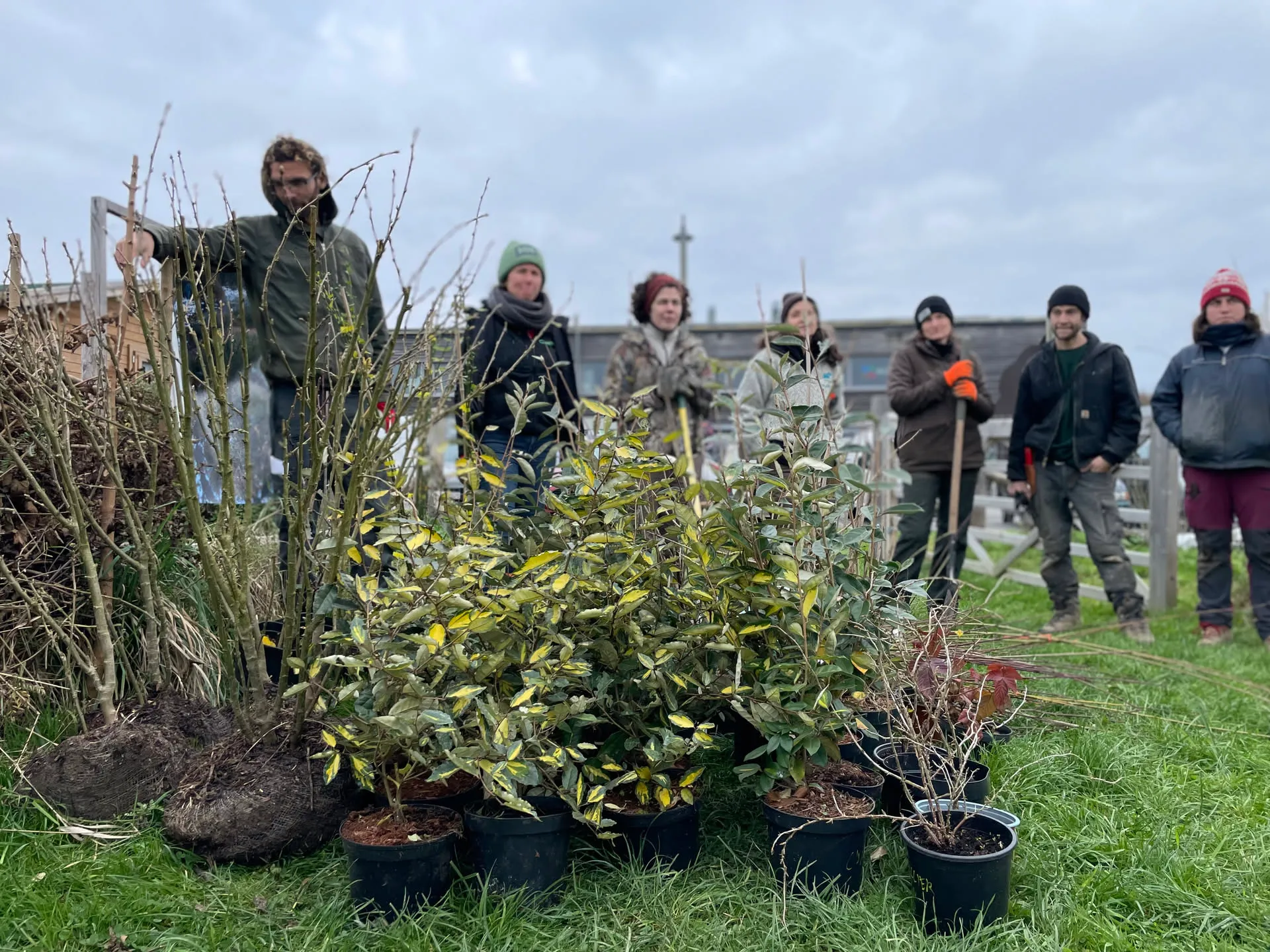
Four questions do the sorting. Where were the plants raised? Are they offered bare-root — cheaper than containers, available from November to March? Can a variety be grafted on request? And is there stock left for next winter, or must you already book for the one after?
Where you start
You have a garden. Measure your run. Beyond twenty metres in a residential zone, the mixed country hedge is worth the file — especially if you have it planted. Below that, plant freely, without paperwork, and choose your species for pleasure rather than for the handbook.
You are carrying a school, neighbourhood or collective project. The length is often there, and a planting day welds a group together. First check who owns the land: without written agreement, no file.
You are a municipality. The grant is only one brick — we have documented the full approach in our offer for towns.
You are a farmer. This is not the article you need, but this one: the eco-scheme and the per-hectare calculation are treated there properly.
November is coming — the best moment of the year to put bare roots in the ground. You do not need a grant to plant a hedge, only to know what you are planting, and why.
And if you would like us to look at your land before you order, there is our food forest coaching for those who plant with their own hands — and the design studio for a project drawn from end to end.
Come, we will show you.